
Chapter 02
From Observation to Hypothesis
Once motion became the variable worth investigating, a new question emerged: what was motion actually doing?
2022–2023
The next question
If it was motion, what was motion doing?
Once we began thinking about motion rather than the boat itself, the question changed.
I started reading everything I could find about motion and the nervous system. That search led repeatedly to the vestibular system, the sensory system that detects movement, acceleration, orientation, and our relationship to gravity.
As I read further, I encountered research examining relationships between vestibular stimulation and broader neurological processes, including autonomic regulation and neuroplasticity.
None of this demonstrated that motion explained what we had observed in our son. But for the first time, there appeared to be a biologically plausible reason to keep asking the question.
Motion
Vestibular input
Nervous system response
A pattern emerged
The activities looked completely different.
The motion did not.
As I continued reading, I encountered reports and research involving experiences that, on the surface, seemed to have little in common.
- 01Hippotherapy
- 02Surfing
- 03Boating
- 04Trains
- 05Swings
- 06Rocking
- 07Water-based motion
- 08Merry-go-rounds and other rhythmic movement
A horse, a surfboard, a boat, a train, a swing, and a rocker look like entirely different experiences.
But from the perspective of the person experiencing them, they can share something important:
Externally applied rhythmic motion.
The question changed again
What if these were not entirely different interventions?
What if they were different ways of delivering a common sensory exposure?
Externally applied rhythmic motion
Could motion be the common ingredient worth investigating?
An important distinction
The environment and the movement were not the same thing.
Being near a horse was not the same sensory exposure as riding one.
Sitting on a stationary swing was not swinging.
A rocker without rocking was simply a chair.
A train at rest was not providing the same movement as a train underway.
Being in or near water did not necessarily reproduce the movement experienced on a boat, surfboard, or floating body.
The environments remained.
The defining motion did not.
These comparisons were not controlled experiments, and they did not establish causation. They changed how I thought about the question.
Instead of asking why horses, boats, surfing, swings, or trains might each produce interesting observations, I began asking whether the nervous system might be responding to something those experiences sometimes had in common.
The hypothesis takes shape
Motion as a common exposure
The wrapper might not be what mattered.
By this point, I had begun to form a more specific hypothesis.
The boat itself might not explain what we had observed.
Instead, the relevant exposure might be externally applied rhythmic motion, acting in part through vestibular stimulation and potentially influencing broader nervous system regulation.
This remained a hypothesis.
I did not know what type of motion might matter.
I did not know what frequencies, amplitudes, directions, or durations might be relevant.
I did not know whether the response we had observed would reproduce in other people.
And I did not know whether the hypothesis was correct.
But there was finally something specific enough to investigate.
Why the water remained important
Boats offered something unusually interesting.
Among the motion-rich environments I had encountered, boating remained particularly interesting.
A vessel on natural water can expose a person to continuously varying movement across multiple axes over an extended period of time.
Pitch
Roll
Heave
And combinations of movement that change with the vessel, speed, heading, wind, waves, and sea state.
We did not yet know which of those variables mattered, if any.
But unlike the broad idea of a "holistic boating experience," motion was something that could eventually be measured.
And we already had one reason we could not easily dismiss the question.
We had seen something remarkable in our own son.
Then the question became personal again
A promise changed what came next.
During this period, my mother became seriously ill.
My wife and I cared for her at home through hospice. For three months, we were with her around the clock. She hated hospitals, and we wanted her to remain at home.
She had also spent the previous year hearing me talk about Parker, what we had observed on the water, and what I was beginning to learn.
Parker and my mother shared an especially close relationship. She was his person, the family member to whom he was especially attached.
Before she died, she made me promise something.
“Sell the house and buy a boat for Parker.”
After she died, we began looking in earnest.
And eventually, we did exactly that.
Version one
The first plan was simple.
We sold our house and purchased a 1973 Moody Carbineer 44.
The idea was no longer simply to give Parker more time on the water.
If what we had observed was real, I wanted to know whether other autistic children might show something similar.
The plan was to bring autistic children and their families aboard for repeated sailing experiences, observe what happened, and begin learning.
We did not yet have a clinical research program.
We did not yet have an institutional research partner.
We did not yet have the technology to reproduce the motion on land.
We had a hypothesis, a boat, and a plan to learn.
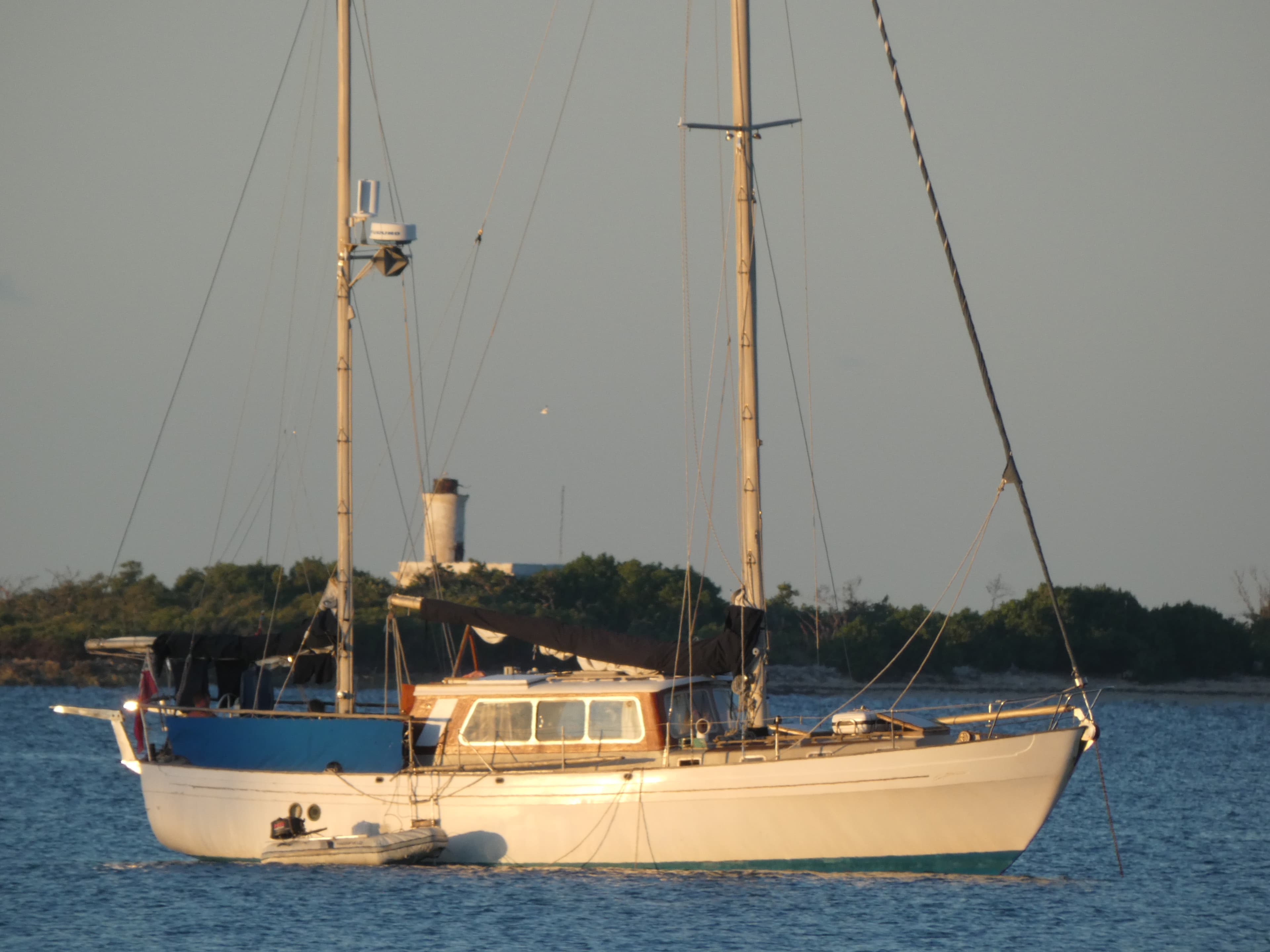
We thought the boat was the beginning of the plan.
What happened next changed the plan entirely.