
01
The Scientific Question
Can externally applied rhythmic multi-axis motion produce measurable changes in physiological, autonomic, and vestibular markers?
CURRENT RESEARCH CAMPAIGN
Phase 1 Research Program
Funding Goal: $4.79M
CURRENT RESEARCH CAMPAIGN
Phase 1 Research Program
Funding Goal: $4.79M
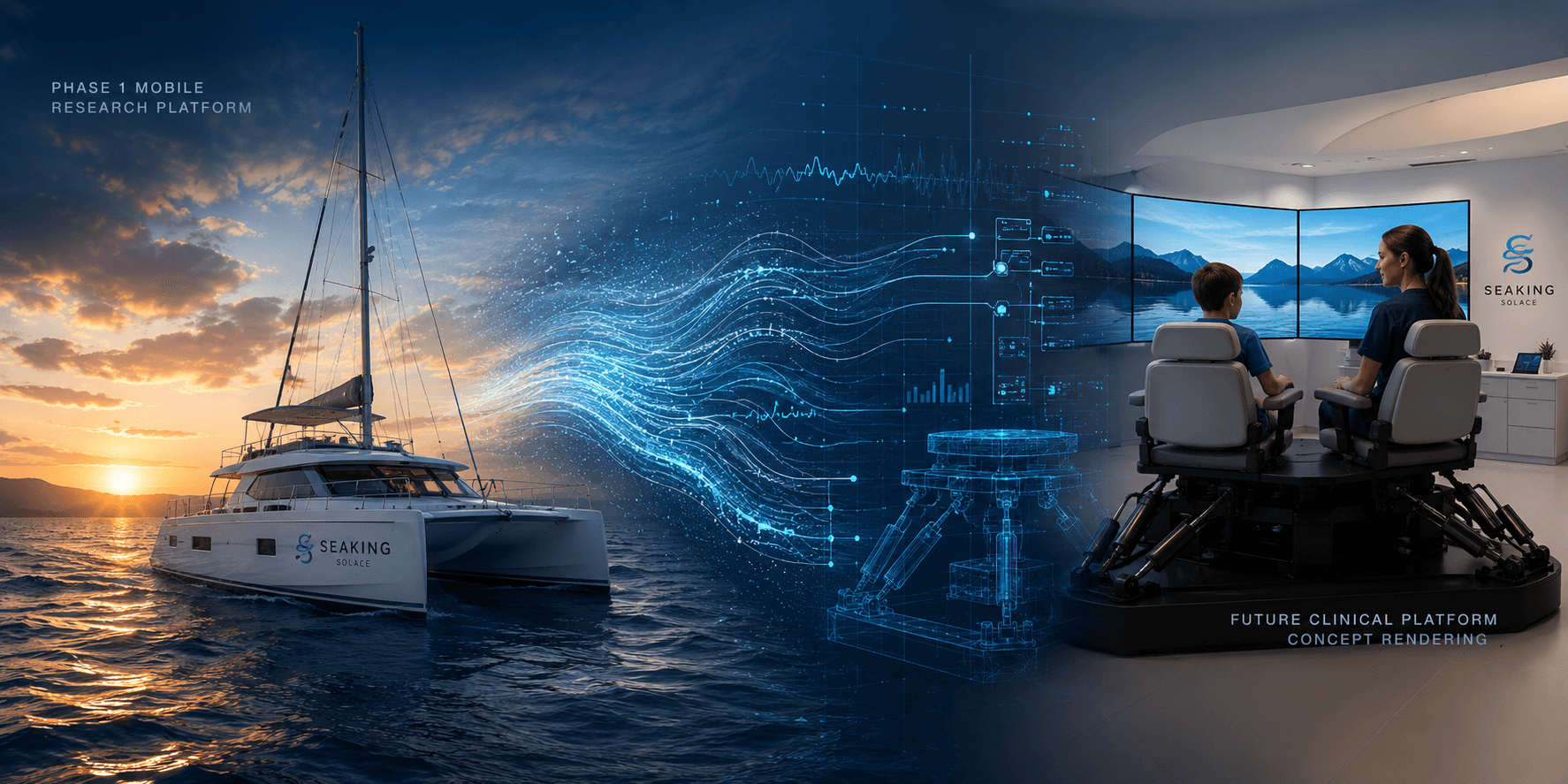
SeaKing Solace is developing a phased research program to investigate how controlled multi-axis motion may influence autonomic regulation and vestibular processing, and whether those findings can support development of a future clinical platform.
A Governed Research Program
SeaKing Solace is developing a phased research program with Thomas Jefferson University to move from real-world motion characterization to laboratory validation and, if supported by evidence, future clinical research and platform development.
The Phase 1 research scope is defined through a signed Statement of Work with Thomas Jefferson University, with Dr. David Whellan serving as Principal Investigator.
01
Can externally applied rhythmic multi-axis motion produce measurable changes in physiological, autonomic, and vestibular markers?
02
Phase 1 is designed to characterize vessel motion and synchronized physiological responses in healthy adult participants.
03
If the findings support continued development, the resulting motion profiles and response data would inform simulator validation and later feasibility research.
04
The program is being structured with Thomas Jefferson University under Principal Investigator Dr. David Whellan, including protocol development, research oversight, ethics review planning, data analysis, and future study design.
The Observation
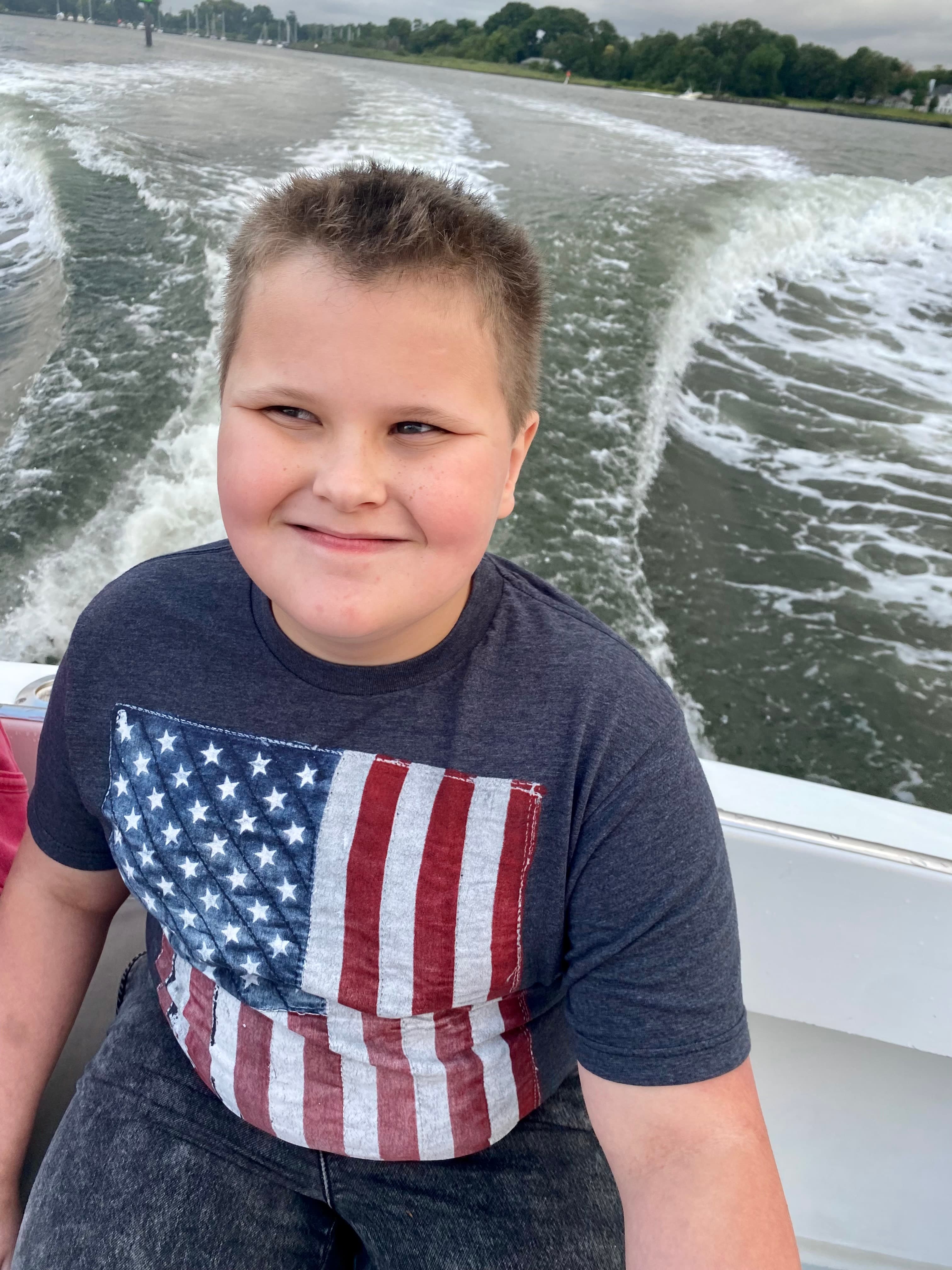
During time on a boat in 2021, we observed an unusually calm and regulated response in our 9-year-old son Parker. The change appeared to continue after the experience ended.
That observation did not establish efficacy or causation. It raised a question that could be investigated scientifically.
SeaKing Solace was formed to determine whether the relevant variable can be measured, characterized, reproduced, and, if supported by evidence, translated into a controlled research and future clinical environment.
The Measurement Framework
Phase 1 is designed to precisely characterize vessel motion while synchronizing a comprehensive set of physiological measurements during repeated on-water research sessions.
The objective is to identify reproducible relationships between multi-axis motion and objective biological responses across multiple physiological systems, without assuming in advance that any particular response is beneficial.
01
High-resolution six-degree-of-freedom motion sensing will continuously quantify heave, pitch, roll, surge, sway, and yaw, creating a time-resolved motion profile for each research session and participant location.
02
Continuous ECG, heart rate, heart-rate variability, respiration, and beat-to-beat arterial pressure will be synchronized with motion data to characterize cardiovascular and autonomic response patterns over time.
03
Pupillometry, gaze and visual-context data, and electrodermal activity will provide additional non-equivalent physiological signals, allowing ocular autonomic and sympathetic sudomotor responses to be examined alongside cardiac and respiratory physiology.
04
Motion, cardiovascular physiology, respiration, electrodermal activity, pupil and gaze data, environmental context, symptoms, and participant events will be time-aligned to identify reproducible motion-response patterns and evaluate competing explanations.
Every measurement is intended to be synchronized to a common timeline so that biological responses can be evaluated in relation to the precise motion profile, participant state, environmental context, and relevant events occurring at that time.
The Research Roadmap
Each phase is intended to answer a distinct scientific and engineering question. Progression beyond Phase 1 would depend on the quality of the data, feasibility findings, available funding, and appropriate scientific and regulatory review.
Phase 1
Current Funding Objective
Characterize vessel motion and synchronized physiological responses in healthy adult participants.
Phase 2
Planned Next Phase
Reproduce selected motion profiles in a controlled laboratory environment and evaluate whether comparable responses can be measured.
Phase 3
Conditional Future Objective
If supported by earlier findings, evaluate safety, tolerability, feasibility, and preliminary response patterns in selected participant populations.
Phase 4
Conditional Future Objective
Develop and evaluate an adaptive system capable of adjusting motion parameters in response to measured physiological signals.
Future
Long-Term Research Objective
Subject to evidence, feasibility, regulatory strategy, and funding, conduct controlled studies evaluating defined clinical applications.
The roadmap is intentionally stage-gated. Findings from each phase are intended to determine whether, and how, the program should proceed.
View the Research ProgramInstitutional Research Collaboration
SeaKing Solace has a signed Statement of Work with Thomas Jefferson University defining the Phase 1 research scope and institutional responsibilities.
David J. Whellan, MD, MHS
Director, Jefferson Clinical Research Institute
Dr. Whellan signed the Phase 1 Statement of Work and is identified as Principal Investigator for the planned research program.
Development and refinement of the research protocol, participant procedures, measurement strategy, and analytical framework.
Institutional oversight of the research process, including ethics-review preparation and study-governance planning.
Support for the planned analysis of synchronized motion, physiological, and participant-response data.
Scientific guidance for subsequent research phases if Phase 1 findings support continued development.
The signed Statement of Work establishes the planned Phase 1 research relationship. IRB approval, participant enrollment, and study activation have not yet occurred and remain dependent on funding and completion of the required institutional processes.
The Current Philanthropic Objective
SeaKing Solace is seeking $4.79M in philanthropic support to fund the planned Phase 1 on-water research program, associated research infrastructure, and the operational capacity required to execute the study.
The purpose of this funding is to generate the foundational motion and physiological dataset needed to determine whether the program should advance to simulator validation and later research phases.
01
Acquisition, preparation, operation, and research use of the sailing catamaran serving as the Phase 1 mobile data-collection platform.
02
Participant sessions, study coordination, vessel operations, staffing, safety procedures, and site-based research logistics.
03
Motion sensing, physiological monitoring, pupillometry, synchronized data capture, storage, and analytical infrastructure.
04
Principal Investigator leadership, protocol development, institutional processes, data analysis, and scientific planning through the defined research relationship.
Phase 1 is intended to produce a characterized library of real-world motion profiles and synchronized physiological-response data. Those findings would be used to determine whether simulator replication and subsequent feasibility research are scientifically justified.
Conversations may include philanthropic gifts, program sponsorship, foundational support, and other mission-aligned funding structures.
Begin a Conversation
SeaKing Solace is seeking mission-aligned philanthropic, institutional, scientific, and technical partners prepared to help advance a carefully governed research program.
The appropriate next step depends on how you or your organization would like to engage.
01
For individuals, families, foundations, and advisors interested in major gifts or foundational support for the Phase 1 research program.
Discuss Philanthropic Support02
For organizations interested in supporting research infrastructure, program operations, measurement systems, or mission-aligned public engagement.
Discuss Program Sponsorship03
For researchers, clinicians, academic institutions, and technical specialists interested in the scientific program or future research collaboration.
Discuss Research CollaborationWe welcome conversations with individuals and organizations interested in understanding the research program, reviewing the current Phase 1 objective, or exploring an appropriate role in its advancement.