
Scientific Review 01
Vestibular System & Motion
Why motion must be characterized before it can be reduced, reproduced, or controlled.
The vestibular system is the body's primary biological system for sensing head motion and orientation relative to gravity. But "motion" is not a single variable.
Natural movement contains simultaneous rotational and translational components that change over time. The vestibular organs respond differently to these components, their responses vary with frequency and orientation, and the central nervous system integrates vestibular input with information about gravity, vision, proprioception, and whether movement was self-generated or externally imposed.
For SeaKing Solace, this creates a fundamental experimental question:
If externally applied natural motion is associated with reproducible physiological changes, what characteristics of the motion actually received by the participant are associated with those responses?
Existing vestibular science does not provide a predetermined therapeutic waveform. It does provide a rigorous basis for measuring natural motion with sufficient dimensional and temporal resolution to investigate that question before selecting a controlled stimulus.
SeaKing Solace Scientific Library
Scientific White Paper • Evidence Review • Vestibular Physiology • Motion Characterization
Full Scientific Review
Download Scientific Review 01 PDF01
Motion is a physical stimulus
The vestibular system is a mechanosensory system. Physical movement of the head is transformed into neural activity through the semicircular canals and otolith organs of the inner ear.
The three semicircular canals respond primarily to rotational head motion. The utricle and saccule respond to gravito-inertial acceleration, which includes both translational acceleration and the gravitational component associated with head orientation.
This distinction matters because a six-degree-of-freedom engineering description of motion does not correspond to six independent biological channels.
A vessel may simultaneously undergo surge, sway, heave, roll, pitch, and yaw, but those motions reach the vestibular system through the geometry and dynamics of the head, semicircular canals, otolith organs, and subsequent central integration.
From environmental motion to vestibular input
Figure 1
From Environmental Motion to Vestibular Neural Input
- 01Environmental motion
- 02Body and head mechanics
- 03Head-centered rotational and gravito-inertial motion
- 04Vestibular end-organ biomechanics
- 05Hair-cell transduction
- 06Vestibular afferent activity
Each stage can alter the relationship between the motion occurring in the environment and the signal ultimately transmitted to the nervous system.
02
Natural motion is multidimensional
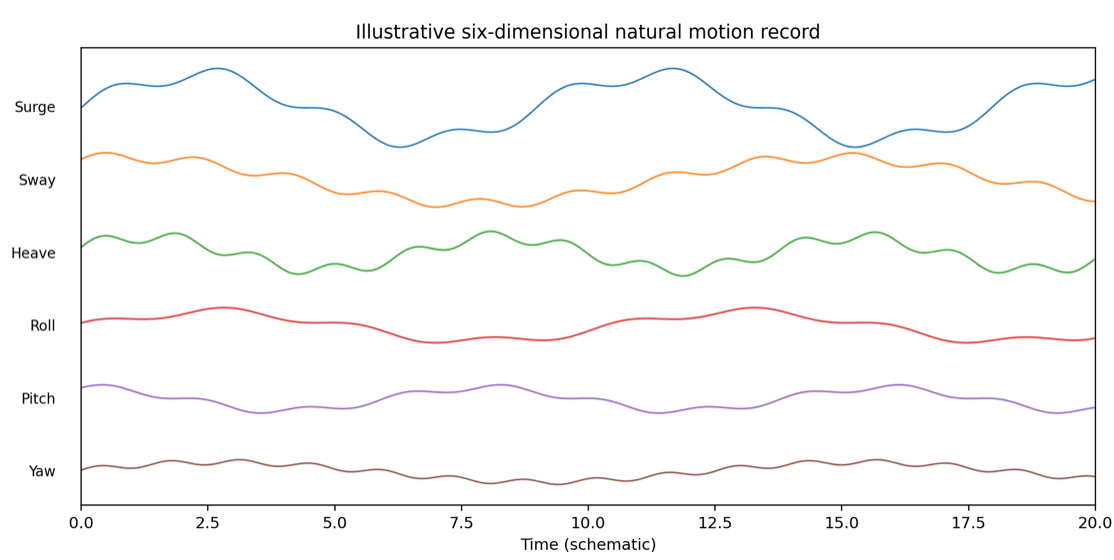
Direct measurements of natural human head motion show that everyday vestibular exposure occurs simultaneously across rotational and translational dimensions and contains complex, activity-dependent temporal structure.
Two periods of motion can therefore have similar average acceleration while differing substantially in frequency content, rotational composition, temporal sequence, cross-axis relationships, or transient events.
Reducing both exposures to a single average would discard information the vestibular system is capable of distinguishing.
That does not mean every measurable characteristic is biologically important.
It means that determining which characteristics matter, which are redundant, and which can eventually be discarded is an experimental question.
Figure 2
Illustrative Six-Dimensional Natural Motion Time Series
Preservation before reduction
The objective is not permanent complexity.
The objective of later controlled experimentation is precisely the opposite: to simplify the stimulus deliberately.
But simplification should emerge from evidence rather than from assumptions made before the relevant variables are known.
03
The vessel is not the vestibular stimulus
One of the most consequential distinctions in the vestibular literature is between environmental motion and head-centered motion.
A sensor mounted to a vessel can precisely characterize how the vessel moves. But the vestibular organs are located in the participant's head, not on the vessel.
Participants turn their heads. They stabilize them. They look downward or toward the horizon. They lean, brace, change posture, stand, or recline.
Those behaviors transform vessel-frame motion before it reaches the vestibular organs.
For vestibular physiology, head-centered motion is therefore the more proximal physical stimulus. Contemporary experimental systems have incorporated real-time head tracking specifically so that vestibular stimulation can be defined relative to the moving head rather than only relative to the motion platform.
Figure 3
Vessel Motion vs. Received Head Motion
What did the environment do?
Vessel-frame 6-DoF motion
What motion did the participant receive?
Participant/head-centered motion
How did the participant respond?
Synchronized physiological measurements
Vessel and head measurements are not substitutes for one another. They answer different questions.
The vessel provides the common external forcing environment. Head measurement describes how that environment was transformed at the participant level.
This distinction may also help explain apparent differences between participants. Two people can occupy the same vessel during the same segment of motion while receiving different head-centered vestibular exposures because of differences in posture, stabilization, orientation, and voluntary movement.
04
Motion is interpreted, not merely detected
Vestibular input does not terminate at the inner ear.
The central nervous system must combine rotational and gravito-inertial information with other sensory and internally generated information to estimate orientation and self-motion.
One important example is the tilt-translation problem.
The otolith organs respond to gravito-inertial force. As a result, translation and changes in orientation relative to gravity can produce overlapping peripheral signals. Central processing uses additional information, including semicircular-canal input, to help distinguish them.
Figure 4
Tilt-Translation Ambiguity
Peripheral signal
Gravito-inertial force
Translation
Tilt relative to gravity
The origin of motion also matters.
Physical head movement may be similar whether it is produced voluntarily or imposed externally, but central processing incorporates motor predictions associated with self-generated movement.
For experimental design, this means unnecessary voluntary head movement and behavioral context cannot simply be assumed irrelevant.
The physical stimulus should be measured as close to the biological target as practical, while participant behavior remains part of the context required to interpret it.
05
Why not simply choose a waveform?
A controlled motion platform offers something a natural environment cannot: precise experimental manipulation.
- Amplitude can be changed.
- Frequency can be varied.
- An axis can be removed.
- Cross-axis relationships can be altered.
- A candidate stimulus can be repeated.
Those capabilities will be essential.
But they create an earlier question:
What should the platform reproduce?
- Which axes?
- Which amplitudes?
- Which frequencies?
- Which temporal envelopes?
- Which cross-axis relationships?
- Which durations?
- Which head-centered exposure?
Existing vestibular science identifies many characteristics that could matter. It does not identify which natural motion features, if any, are associated with the physiological response SeaKing Solace proposes to investigate, nor does it provide an established waveform for that proposed endpoint.
Selecting a fixed laboratory waveform before answering those questions would require assumptions about the very stimulus the research program is intended to investigate.
06
Why natural motion?
A vessel is not being treated as a therapeutic device in Phase 1.
It is being used as a natural motion-generating environment.
Natural vessel motion produces continuously varying combinations of translation and rotation over extended periods without requiring investigators to specify in advance which waveform deserves testing.
That allows environmental motion, participant head motion, physiological response, behavior, and tolerability to be measured together while the stimulus varies naturally.
This is fundamentally different from claiming that the boat itself is therapeutic.
If the motion-centered hypothesis is correct, the relevant stimulus should ultimately be separable from the environment in which it was first observed.
Natural variability is not arbitrary randomness
Natural vessel motion should also not be confused with independently randomizing six motion axes on a laboratory platform.
Marine motion emerges from a physically constrained dynamic system. Translational and rotational components evolve together through vessel dynamics and environmental forcing.
A controlled platform can eventually test and manipulate those relationships. But generating artificial variation before the relevant natural stimulus space has been characterized would again require investigators to decide which combinations and temporal structures should be generated.
The natural environment therefore serves a different scientific purpose from the controlled platform.
07
Discovery first. Causality second.
The boat and the controlled motion platform are not competing experimental approaches. They answer different questions in sequence.
Natural motion environment
- Characterize
- Measure multidimensional environmental motion.
- Associate
- Determine whether characteristics of received motion covary with physiological response.
- Replicate
- Determine whether candidate relationships recur within and across participants.
Controlled motion platform
- Reproduce
- Reconstruct candidate head-centered exposures under controlled conditions.
- Manipulate
- Change individual characteristics while holding others constant.
- Reduce
- Determine which components are necessary, sufficient, redundant, or unnecessary.
- Establish response functions
- Characterize amplitude, frequency, duration, temporal structure, and tolerability where justified.
- Advance only if supported
- Clinical testing and eventually adaptive control become later questions only if preceding relationships survive controlled investigation.
Figure 5
Evidence-Gated Progression From Discovery to Controlled Testing
- Characterize
- Associate
- Replicate
- Reproduce
- Ablate / Reduce
- Dose-Response / Clinical
- Adaptive Control, if justified
The objective of controlled stimulation is therefore not simply to replay an interesting vessel trajectory.
It is to convert candidate associations into variables that can be tested for necessity, sufficiency, dose-response behavior, and interaction.
08
Physical reproduction is not necessarily biological reproduction
The head-centered distinction becomes even more important when moving from the vessel to a laboratory platform.
Suppose Phase 1 identifies an interesting vessel-motion profile.
Replaying that exact vessel trajectory on a motion platform does not guarantee that the participant receives the same vestibular exposure.
Seat geometry, posture, restraint, anticipation, visual environment, body mechanics, platform pivot location, and head movement can all alter the motion ultimately reaching the vestibular organs.
Can the platform replay the vessel waveform?
versus
Can the platform reproduce the relevant received vestibular stimulus, and does the associated physiological response reproduce?
That distinction separates physical reproduction from biological reproduction.
09
The path toward control
If reproducible stimulus-response relationships are eventually established, the same distinction has implications for the long-term engineering pathway.
A motion platform commands movement at the machine.
Its biological target is the participant.
Control pathway
Commanded Stimulus to Control Adjustment
- 01Commanded stimulus
- 02Delivered platform motion
- 03Received head motion
- 04Measured physiological response
- 05Control adjustment
Head-centered stimulus control and physiology-driven closed-loop control are separate scientific and engineering problems.
The first asks whether the intended physical vestibular exposure was actually delivered.
The second would ask whether that exposure should be adapted in response to measured physiology.
The latter becomes justified only if stable and reproducible input-output relationships are demonstrated first.
10
Tolerability defines the usable stimulus space
A measurable physiological response is not automatically a desirable response.
Motion sickness itself can produce changes in heart rate, HRV, pupil dynamics, and other autonomic measures. Candidate physiological signals must therefore be interpreted alongside symptoms, behavior, and tolerability.
For Phase 1, motion exposure, physiological response, symptoms, and participant behavior should be synchronized closely enough to help distinguish candidate responses from adverse motion-sickness trajectories.
The eventual objective is not to maximize motion or physiological response.
It is to identify reproducible relationships, if they exist, within a stimulus region that remains acceptably tolerated.
11
What Phase 1 is designed to discover
- 01
Natural externally applied motion can be characterized with sufficient dimensional and temporal resolution.
- 02
Environmental vessel motion can be distinguished from participant-specific head-centered exposure.
- 03
Specific characteristics of received motion are reproducibly associated with synchronized physiological responses.
- 04
Candidate relationships recur across repeated exposures and can be distinguished from behavioral, contextual, and tolerability effects.
- 05
The resulting evidence is sufficient to justify controlled reproduction and causal testing.
These are discovery questions.
They do not require investigators to know the final waveform before the study begins.
That is precisely the point.
12
Evidentiary boundary
13
What the evidence allows us to ask
The conclusion of this review is not that the SeaKing Solace hypothesis has been proven.
It is that the early portion of the hypothesis can be expressed as a rigorous and falsifiable experimental program.
Existing vestibular science supports the early links strongly enough to justify asking whether characteristics of naturally occurring, externally applied motion can be related reproducibly to measurable physiological responses.
If candidate relationships are identified, controlled studies can then determine whether they can be reproduced, manipulated, reduced, parameterized, and eventually translated into a controlled stimulus.
The literature does not tell SeaKing Solace what motion should become the intervention. It tells us why motion must first be measured well enough to determine whether a reproducible, controllable intervention exists within it.
14
The evidence architecture
Figure 6
Established Science | SeaKing Solace Hypothesis | To Be Determined
Established vestibular science
- Natural motion is multidimensional and temporally structured.
- The semicircular canals and otolith organs encode different aspects of head motion.
- Vestibular processing depends on frequency, orientation, context, and exposure history.
- Central processing integrates canal, otolith, visual, proprioceptive, and internally generated information.
- Self-generated and externally imposed motion can be processed differently.
- Vessel or platform motion and received head-centered motion are physically distinct variables.
SeaKing Solace hypothesis
- Features of externally applied natural motion may be associated with reproducible physiological responses.
- Participant-level head motion may improve characterization of the relevant physical exposure.
- Candidate stimulus-response relationships identified in natural motion may be reproducible under controlled stimulation.
- The effective stimulus, if one exists, may ultimately be reducible to something substantially simpler than the natural environment in which it was discovered.
To be determined experimentally
- Which motion characteristics matter.
- Whether candidate motion-physiology relationships reproduce.
- Whether those relationships are causal.
- Whether a controlled platform can reproduce the relevant biological response.
- Whether the stimulus can be simplified.
- What dose, duration, and tolerability boundaries apply.
- Whether physiological modulation produces clinical benefit.
- Whether individualized or closed-loop control ultimately adds value.
Read the Full Scientific Review
Vestibular System & Motion
SeaKing Solace Scientific Review 01
Scientific Review 01 • 45 pages • 49 references • 8 figures • 3 tables
The complete review examines peripheral vestibular anatomy and encoding, canal-otolith integration, natural multidimensional motion, frequency and temporal structure, active versus externally applied movement, head-centered exposure, individual variability, adaptation, tolerability, controlled reproduction, and the methodological rationale for the SeaKing Solace research program.
Download Full Scientific Review